Ideas
The Internet Is Getting Harder to Trust.
October 4, 2026 · 2 min read
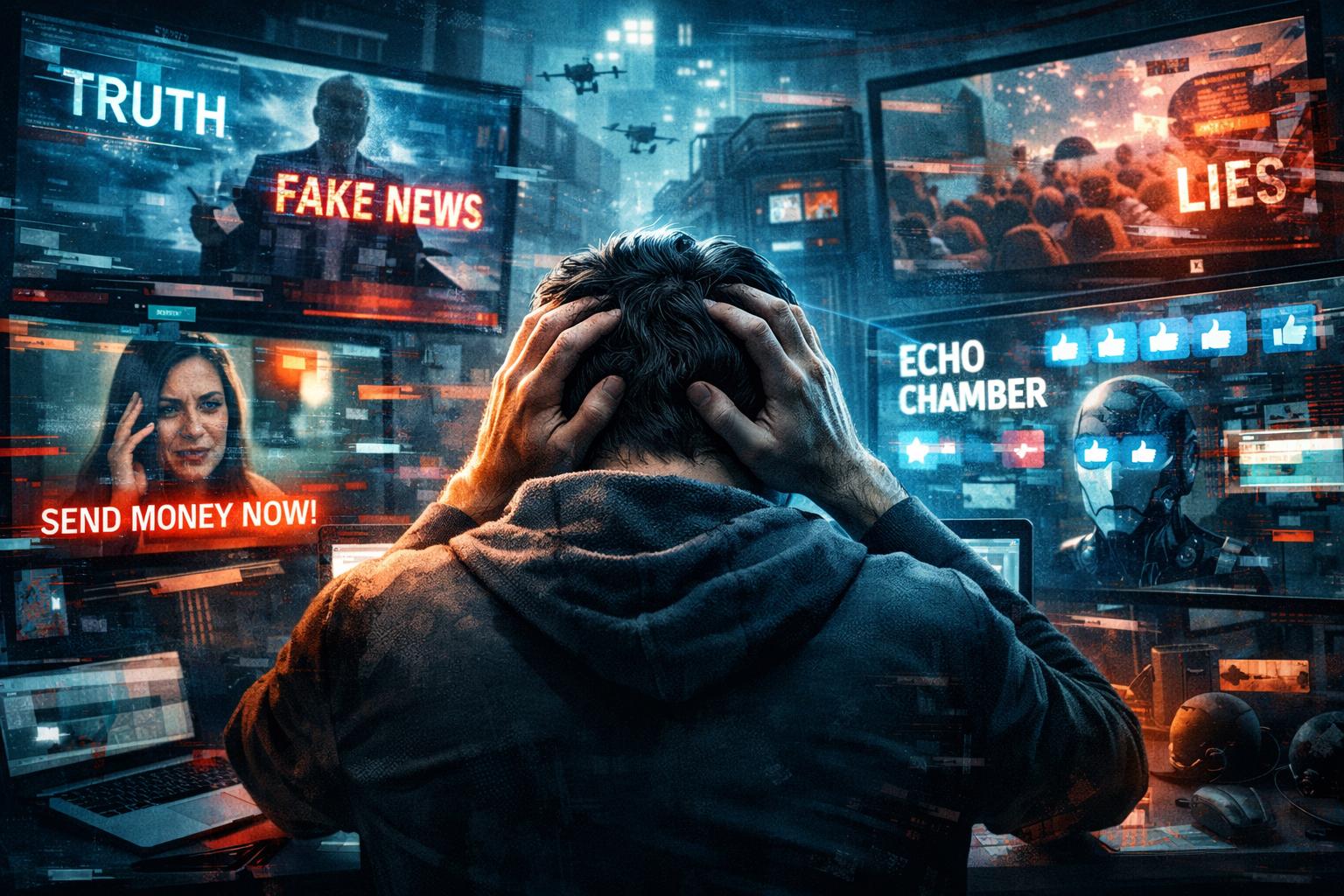
There was a time when seeing something online felt like discovering information.
Now, seeing something online often raises a different question:
Is this even real?
A photograph can be generated in seconds. A voice can be cloned. A video can be manipulated. A headline can be completely fabricated and still look like it came from a legitimate news organization.
The internet hasn't stopped giving us information.
It has made information incredibly cheap.
And that creates a strange problem: when almost anyone can create something convincing, figuring out what deserves our trust becomes harder.
We Used to Worry About Fake News
Now we're entering something more complicated.
Fake news used to require effort.
Someone had to write an article, create a website, manufacture a story, or manipulate a photograph.
Generative AI has dramatically lowered the barrier.
Today, producing convincing text, images, audio, and video can take minutes.
That doesn't mean everything online is fake.
It means we can no longer assume something is real simply because it looks real.
And that's a profound change.
Seeing Isn't Believing Anymore
For most of human history, witnessing something was powerful evidence.
You saw a photograph?
It probably happened.
You heard someone's voice?
It was probably them.
You watched a video?
You assumed you were watching an actual event.
That assumption is weakening.
A convincing video may be synthetic.
A voice message may not be from the person you think it is.
A photograph may depict something that never existed.
The technology isn't necessarily the villain.
The problem is that our instincts haven't evolved as quickly as our tools.
The Real Currency Is Trust
When information becomes abundant, information itself becomes less valuable.
Trust becomes more valuable.
Who published this?
Why did they publish it?
Where did the information come from?
Can another independent source verify it?
Those questions are becoming essential.
In the future, knowing how to verify information may be almost as important as knowing information itself.
So What Do We Do?
We don't need to become paranoid.
We need to become slightly more skeptical.
Before sharing something shocking, pause.
Before believing a spectacular claim, look for another source.
Before accepting a viral screenshot as evidence, ask where it came from.
And when something makes you extremely angry or excited, be particularly careful.
Because outrage and amazement are excellent fuel for algorithms.
The Internet Isn't Becoming Useless
It's becoming more complicated.
There is still an extraordinary amount of knowledge online.
There are brilliant writers, researchers, teachers, journalists, creators, scientists and communities sharing valuable work every day.
The challenge isn't finding information anymore.
It's knowing what deserves your trust.
And perhaps that's the next great internet skill:
Not searching faster.
Not scrolling faster.
Knowing when to stop and verify.